

“Gentlemen, I am tormented by questions; resolve them for me.”
Dostoevsky, Notes from Underground
As the blood drips into the vial, I rue how little of genetics I remember. It is April 2017, an eternity since I stared out the window in high school biology. Now I stand here holding Misha’s sweaty palm and relying on a platoon of metaphors to contemplate the secret of my son’s nature.
The doctor compares the genome with an instruction manual. Proteins are the syllables that activate the genes. Nucleotides are the letters that carry the code. Think of the chromosomes, the object of today’s inquiry, as numbered pages. Once the doctor ships Misha’s sample to the laboratory, a microarray analysis will count them. Are the pages of his manual all present and accounted for?
The doctor slightly unnerves me. His toothy smile and pigeon chest remind me of the pitchmen in breakfast cereal commercials. In reality, Brian Skotko is Professor at Harvard Medical School and Director of the Down Syndrome Program at Massachusetts General Hospital. Down Syndrome is one of the neurodevelopmental diagnoses attributable to a discrete chromosome variation. I have come to find out whether Misha’s autism diagnosis is likewise attributable. Such genetic variations, as Dr. Skotko explains, may come to roost in a newborn either via inheritance or interactions between egg and sperm. The latter cases, spontaneous occurrences of combined “germline” cells, are “de novo,” new. I remember enough Latin to stay in the conversation.
Lo and behold, the microarray discloses a variation in chromosome 11q. The extra letters on that page run along a belt of seven-and-a-half million nucleotides. Neither his mother nor I, nor his sister Niusha, share the duplication. His is de novo, from the germline. All it took for him to draw this lottery ticket was one errant bounce of the buttocks.
The standard algorithm classifies variations from “benign” and “likely benign” to “likely pathogenic” and “pathogenic.” Misha’s is a “variation of uncertain significance,” a classification not uncommon in a young field chockablock with reports of de novo variations. Dr. Skotko will consult medical research published on 11q. I will consult rarechromo.org, a global repository of parent reports. If 11q is inculpated in autism, those sources will tell us. When we reconvene, however, we break the same news. The repository contains no reports of 11q. Of the medical research, Dr. Skotko says “there are no cases that we are aware of that are the same size as Misha’s.”
Is Misha’s duplication, new to him, new in nature as well? Or does a dearth of reporting account for his matchless status? Dr. Skotko cannot say. “Your son,” he does say, “is on the far edge of science.”
Over the next four years, I drag Misha through Boston’s most distinguished hospitals and clinics, where he picks up additional diagnoses. An occupational therapist at Mass General ascribes impairments in his motor control to sensory processing disorder. Margaret Bauman, renowned neurologist at the Integrated Center for Child Development in Newton, Massachusetts, orders metabolic tests to find out whether mitochondrial DNA disease can explain his bandy musculature. It does not. Timothy Buie, equally renowned as a gastroenterologist at Boston Children’s Hospital, orders antibody tests to find out whether he has inflammatory bowel disease or celiac disease. He does not. A neuropsychologist at the Lurie Center for Autism diagnoses Misha with mixed-expressive-receptive language disorder. Does an impairment in bilateral hearing explain it? Nope, says an audiologist.
After Barry Kran at the New England College of Optometry diagnoses cerebral vision impairment, a neuro-ophthalmologist at Boston Children’s conducts a structural MRI of Misha’s brain. “The MRI was normal,” reports Dr. Gena Heidary. The images reveal no evidence of abnormal anatomy, no signs of injury or stroke or trauma, no underdevelopment of the regions that host executive function. Cerebral vision impairment is a neural kink in the process by which objects in the environment become subjects of perceptual discrimination. Where is the kink?
“It is the case that some of our children with CVI have clear injuries to the visual pathways, and we can see it,” Dr. Heidary responds. “We also have children with no clear injuries.”
“It seems impossible that Misha has a normal brain.”
“We don’t have the sophistication to really tell at the level you’re asking.”
Perhaps it is time to revisit the meaning of the 11q duplication. Could his chromosome variation be lurking in the matrix after all? Lineagen, the laboratory that had analyzed the microarray, makes a genetic counselor available in October 2021. As we delve in, I can hear myself speaking with a forked tongue. The intellectual historian Mark Lilla gives my conflict a clear voice in Ignorance and Bliss: “How is that that we are creatures who want to know and not to know? How is it possible for both desires to inhabit the mind?”
Emily Palen’s opening statement sets the table. “It’s very likely the explanation for his diagnosis of autism,” she states. Variations of uncertain significance fall between −0.89 and 0.89 on the algorithmic scale. The likely pathogenic start at 0.90. Initially, Misha’s was scored 0.88. Emily offers that just before our call, Lineagen’s analysts had rescored his duplication to 0.90, bumping him over the threshold. On what basis and for what reasons the analysts had undertaken to do so? Emily does not say.
“Okay, but if we all have some variations, and if Misha’s duplication has never been reported before, then how can you think Misha’s duplication is ‘very likely the explanation’ for his autism?”
“What we know about these types of genetic changes—pretty sizable duplications or extra sections of DNA—is they tend to have an impact on brain development, and we know there are several genes in this region that we call ‘highly expressed,’ or more active in brain development, so that’s why I’m suspicious that this is likely related to the developmental difference that we know about in Misha, likely related to that diagnosis of autism.”
“But autism isn’t definitively correlated with any genetic conditions, is it?”
“So, there’s a handful of particular genes and a handful of other copy-number changes like the one that we saw in Misha that we know are more common in individuals with autism, developmental delays, and other differences in brain development. So, there is—I don’t want to use the word ‘list’—a group of genetic changes that we know are more common in those individuals and not common in the general, typically developing population.”
“You keep saying ‘autism and other developmental delays.’ I’m specifically interested in autism as it is diagnosed in the DSM. From that diagnosis, his treatments ensue. You’re saying there are genes that are definitively and specifically linked with autism?”
“Yes.”
“And some of those are found within Misha’s duplication?”
“Not that we know of, at this point.”
“So, you haven’t discovered genes that show up specifically in Misha’s sample and that are definitively correlated with autism.”
“Right.”
“But you infer, based on the fact that some genes are definitively linked with autism, that some genes within Misha’s region may also be associated with autism? I’m just trying to figure out the basis for your inference that because you have found some genes that are correlated with autism in other regions, you conclude that other genes, duplicated in Misha’s region, are ‘very likely’ to be correlated with autism.”
“So, I think I’ll back-track and rephrase how I presented that information. Within this duplication there are genes that we know are more highly expressed in the brain and seem to be pretty critical for brain development.”
“Okay, got that.”
“Since the body has them turned on more often in the brain’s tissue, we suspect they play a pivotal role in brain development. So, historically, those types of genes—those that are highly expressed in the brain and that we suspect are critical for brain development—we can consider a category of genes. We know that, in other individuals with autism, that category of genes tends to be more common for mutations or maybe deletions or duplications involving those genes.”
“So, the relevant category is ‘genes that are more highly expressed in brain development.’”
“Yes.”
“Help me understand the incidence of duplications in that category.”
“In Misha’s duplication, there are eleven genes out of sixty-six that we would put into that category of highly expressed in brain tissue, probably important for brain development. Of all of our genes—we have twenty thousand—there are many many, many genes that are important for brain development. What we know about Misha so far is that those elevation genes that we identified in his duplication out of the sixty-six we know, we suspect are important for brain development based on their expression. This is what we know of him so far, from the microarray.”
“Got it. But the genes that are important for brain development, presumably they are suspects in developmental disorders other than autism, right?”
“Yes, and that’s why I was using the canned language of ‘autism and other developmental disorders.’ We know this is just one genetic factor. We know that there are many other genetic factors at play in each individual. So, sometimes we meet with families, and the child has a diagnosis of autism and other diagnoses. So that’s why I used the group language.”
“The more I observe Misha and learn about autism, the less I understand autism and the more I learn about Misha. That’s why I’m trying to drill down to the relationship, if any, between the cluster of genetically linked behavior that supports the diagnostics of autism.”
“We don’t have enough research or information to say Misha’s duplication is pathogenic. That’s why we say it is ‘likely pathogenic.’ But I think based on the size of the duplication and based on the fact that there are genes within that duplication that we know are expressed in the brain tissue, I think it’s likely—I know it’s frustrating for both you and I that I cannot be more concrete—that it’s the answer to his diagnosis of autism. I think it’s likely based on what we know about, at this point in time.”
“But he doesn’t talk. He doesn’t have language.”
“Right, and that’s related to his diagnosis of autism, correct?”
“You tell me! Why do some kids with autism have language and others don’t? As far I have been able to tell, nobody knows the answer to that question.”
“Yeah, that’s my understanding as well. I think if you and I could figure out that question, then we’d be millionaires.” I think then Misha might speak.
Emily’s “canned language of ‘autism and other developmental disorders’” nettles me. Autism is a spectrum disorder, a junk-drawer diagnosis. Any two children may receive it without sharing a behavioral symptom. Given that only the diagnosed undertake microarrays in the first place, how can Lineagen adequately detect and sub-sort their populations? The difficulty is not that such researchers are not finding de novo variations. The difficulty, as I understand it, is that they are finding too many—and trumpeting matching incidences as statistically low as a fraction of a percentile.
“Genetics is an exact science, isn’t it?”
“It is and it isn’t. Even though we have these results and find them ‘likely,’ the explanation for the behavioral diagnosis of autism, unfortunately it doesn’t provide us with a guidebook or a rulebook of what therapies or what strategies might be most effective.”
“It sounds like these results don’t provide us with the answer to the question of ‘how likely?’ That’s a matter for probability, and a pretty crucial one, no? One in a million carries a different implication than one in ten. You say the duplication is ‘likely pathogenic.’ Can you answer the question of ‘how likely?’”
“Um, not exactly.”
“Okay, but you still think, based on these results, that scientifically speaking 11q is the key to Misha?”
“I think so, yes. My gut feeling—if that’s okay with you—my intuition, is that 11q is the key to Misha. This is likely the piece of the puzzle as to what makes Misha Misha.”
“Even if you’re correct, how do you know you will still be correct in a few years? He will change, right? One of the implications of your discussion of highly expressed genes in early brain development seems to me that those may become less relevant as he becomes older and therefore that his profile might change. I sometimes hear about children ‘growing out of autism.’ Which gives me pause. But it sounds like there’s no way of having a hunch about that, at this point, given how little we know about 11q and what the specific genes in his duplication may represent—beyond the general category of seemingly important for brain development because they are highly expressed.”
“Yes, that’s right. Based on this result, based on what we know of it right now, I expect he’s going to continue to make progress. He will continue to show us his strengths and where he needs support.” Boo! Emily retreats to platitude.
“Well, he may show us where he needs support, but the efficacy and potential harm of that support will depend on how his clinicians are looking at him and listening to him in relation to his diagnostic profile. If they look and listen only through the diagnostic lens of autism, then they might miss a lot. I’m sorry, but I simply don’t understand your confidence. I understand the utility of the diagnosis, but I am still searching.”
“Yes, for some families, they need a name for what’s going on. It sounds like in your case that’s not the situation. I’ve worked with other families who have said ‘I just needed to know what to call it, what label to call my child’s behavioral diagnosis or their challenges.’ For some families, they just need that term, to have something to call it. And other families don’t.”
After we hang up, it occurs to me that Emily misunderstood my motivation. I do not want a name because I crave an illusion of perspicacity. I had put her through her paces because I crave objective truth, and I had persisted over the course of an hour because I sought to reconcile discrepancies in her testament. Genetics “is and is not” an exact science? In one breath she conceded “we don’t have enough research or information to say Misha’s duplication is pathogenic,” and in another propounded her personal intuition that it is “the key to Misha.”
My own posture had not lacked for contradiction. I requested genetics counseling, then turned it into an agon. I might as well have barged into a church to palaver with a priest. In shifting the burden onto Emily, was it knowledge that I had sought, or the grounds to resist knowledge?
An opportunity to find out comes unbidden three months later. Lineagen’s Allison Ortega solicits me with a request to enroll Misha in a research study. Molecular sequencing, the methodology, would “read through letter by letter, nucleotide by nucleotide, so see if there are any differences in the spelling of particular genes that could impact how those genes are functioning in the body.” The microarray counted Misha’s chromosomes, inspected their structure. Molecular sequencing can target particular genes, detect anomalies in their functionality.
Allison elaborates the institutional context. Lineagen is broadening the forensic scope of molecular sequencing from physical deformities to intellectual and developmental disabilities. “We hope to generate data and to publish that data in order to help other families who are looking at those types of symptoms and want to know if they’re related to a genetic diagnosis,” she says. Allison offers to send a “mobile phlebotomist” to our doorstep to collect a vial of Misha’s blood. In exchange, Lineagen shall pay us sixty dollars.
“And what would be the benefit to Misha?”
“It’s hard to say,” Allison answers. I ask her to try. The purpose of the study, she eventually discloses, revolves around Optical Genome Mapping (OGM), a new machine-learning model that Lineagen hopes will identify genetic diseases “faster, easier, and cheaper.” That night I find myself flipping through the Annual Report of Bionano Genomics. The company has recently acquired Lineagen for the sake of its signature innovation, which is called Saphyr. Bionano has reaped $350 million from investors banking on Saphyr to operationalize the OGM model. If the research study in which Allison wants me to enroll Misha winds up validating Saphyr, then Bionano may obtain a medical license. In that event, the company can begin selling to hospitals, clinics, and labs.
“Your new owners want to sell Saphyr for prenatal autism screening, correct?” I put to Allison during our next call. “The tool would be useful to families who would want to abort children like Misha. I won’t even ask you to deny that.”
Allison does not deny that. “There is an arm that is looking at prenatal testing,” she confirms. Still, she stipulates, there are reasons other than abortion for parents to elect prenatal genetic screening. Saphyr could help estimate the odds of a child developing cancer, heart disease, immune deficiency, or epilepsy. Parents forewarned could plan for more robust and refined monitoring and mitigation than currently available.
The humanitarian motive calms my conflict, even inspires me. What if his contribution cures legions of cancerous children? A Henrietta Lacks of our time! I amuse myself with the notion of a counteroffer. Sixty dollars seems low.
Then the bait and switch dawns on me. Allison had baited me with the idea that Misha’s duplication could help children with his duplication get a jump on cancer, heart disease, and epilepsy. Yet she knows as well as I do that Misha has never evinced symptoms of any such diseases. Lineagan had turned up no predisposition for disease, no principle of degeneration. Bionano’s investors have their switch set on his autism diagnosis. “The Last Leaf,” by Oliver Wendell Holmes, Sr., serves as my answer to the solicitation:
And if I should live to be
The last leaf upon the tree
In the spring,
Let them smile, as I do now,
At the old forsaken bough
Where I cling.
Dr. Skotko is partial to Emily Palen’s interpretation. It is May 2022, five years since the microarray, and despite myself I have returned for more. A developmental pediatrician at Massachusetts General Hospital has bestowed upon Misha intellectual disability, bringing his diagnoses to seven. His 11q chromosome duplication remains the sole reported case.
“It leaves us with a sense that this may very well be the answer,” Dr. Skotko asserts, “that this might be the explanation for everything.” I relate why I demurred over Bionano’s research study in molecular sequencing. I ask him to think with me about the clinical value of the same, a distinction that would at least allow me to control applications of any new knowledge. He offers that autism genetics has made rapid strides in the last five years. “There are several hundred genes that we now know, when changed, can lead to some of the characteristics of the diagnosis,” he announces. Moreover, Gene DX has developed a “state-of-the-art” Autism Spectrum Panel to zoom in on those very genes. Molecular sequencing could “bring an end to your diagnostic odyssey.”
Do I want the odyssey to end? Is a fear of conclusory evidence why I allow Dr. Skotko to irritate me with his desultory sprinkling of “cause” and “determine” in sentences otherwise loaded with such medical jargon as “heterozygotes?” Does he expect me to take it on faith that he is privy to the mechanism of action vouchsafing Misha’s symptoms to his nucleotides? An inferential leap of such enormously indeterminate proportions is virtually a divination. “We always start with the diagnoses,” he avers, “and then we, together, as detectives, see what genetics has to say.” What if “we” are starting with a diagnosis that breeds false positives? My reasoning begins with the particulars of Misha and then searches out generalities. Dr. Skotko, reversing my sequence, begins with the Diagnostic and Statistical Manual, as though the point of the investigation were to validate an artifice of nouns and verbs. For Sherlock Holmes, molecular sequencing is elementary, just a method for the most efficient application of means to a logical symmetry of causality, explanation, and prediction. Method plus model plus technique equals end-in-itself. Dr. Skotko deals in know-how. I want to know who wants to know, even if I am not altogether certain that I myself want to know.
I cite a history of breakthrough technologies that have never actually broken through. Autism became a checklist diagnosis in the third edition of the DSM, the same edition that heralded a “biological revolution.” A vanguard of researchers in the 1980s went forth armed with electroencephalography, computerized axial tomography, positron emission tomography, magnetic resonance spectroscopy, and magnetic resonance imaging. The technology freed neurobiologists from having to section postmortem tissue—live brains, unlike other organs, cannot be biopsied—and set the field on a mission to network their anatomical, electrical, and chemical functions. The inward searchlight of the revolution was to have discovered correlations between neuro-developmental phenotypes and brain hemispheres and subregions, perhaps even to have validated the “localization” thesis that had been kicking around since the 1880s.
The biological accountants of neurobiology have advanced treatment options in autism not one jot. Misha, for his part, has been pictured by a neurobiologist, neuroimmunologist, neuropsychologist, neuro-ophthalmologist, and neuroradiologist. When the latter, Dr. Richard Robertson, pronounced his structural MRI normal, the friction between my will to know and my will to not-know generated questions. I asked about the size of the algorithm’s data set. I assumed the concept of a normal brain derived from the nineteenth-century’s vision of the “average man” and the concomitant birth of inferential statistics. I questioned whether mechanical instrumentalism could see Misha.
No reply. I downloaded the images. I thought I might frame a souvenir. I scanned the first several dozen of the 1,431 set and closed the file. In their spectral mystery I perceived no beauty.
Dr. Skotko, too, brushes me off. He exhibits no appetite for debating the empirics of methodology or the metaphysics of inference. If I reject molecular sequencing, he will chalk it up to impudent subjectivity. If I elect to proceed, I will fall into line with the conventional justification for such ventures: scientific investigation ripens in the fruits of its discoveries. “If we find this gene,” he claims, “it might come with a medical playbook. We might learn, for example, that at age twenty-five Misha will be prone to bone cancer.” Bone cancer?
That October, five months after I swallowed the bait, the data extracted from the buccal swabs come in. Gene DX has sequenced Misha’s genes against “all the genes that we know are associated and causative of autism spectrum disorder,” Dr. Skotko confirms. Roll of the drum . . . “They are all programmed typically in Misha.” Having undertaken the microarray and the sequencing, “you’ve done all the latest and greatest testing for autism.” We have discovered nothing. I am pleased.
Although Gene DX found no hits for autism (or bone cancer), the sequencing did reveal another de novo variation. This second variation, a deletion, is located in Misha’s RASA-2 gene. Like the chromosome duplication, it is classified as a “variation of certain significance.” Also like the duplication, it has never been reported in medical genetics.
Two weeks later we are consulting with Dr. Amy Roberts, a cardiovascular geneticist at Boston Children’s Hospital, listening to her explain that RASA is the pathway that cells take as they multiply. “If you’ve altered the pathway—the cell-multiplication pathway—to the point that it’s down-regulated, then you can have growth issues, cognitive issues, narrowing of the heart valve, blood-clotting problems.” Variations causing down-regulation in the RASA-2 pathway, Dr. Roberts continues, have been associated with Noonan Syndrome. I have confidence we are in the right place. Dr. Roberts is “the super-duper expert on Noonan,” according to Dr. Skotko’s referral.
Misha appears to have some features “that could potentially be consistent with Noonan,” the doctor opines during the examination. His eyes slant downward a little. The spacing between his nipples is a mite wide. He bears diagnoses of language impairment and developmental delay. All the foregoing are Noonan characteristics. Yet his neck is not webbed. His stature is not stunted, and his testes are not undescended. He is a tall boy, with balls.
Because Noonan often comes with congenital heart disease, Dr. Roberts orders an echocardiogram. She also orders bladder and renal ultrasounds and a blood clotting screen. Everything checks out normal. She cannot diagnose Noonan Syndrome. “We don’t have information about his particular deletion,” she concedes of RASA-2. “And he’s a boy who has a chromosome change as well; understanding how those two things do or don’t interact is impossible for me to really know.”
At ten years old, Misha carries diagnoses of autism, speech and language disorder, cerebral vision impairment, intellectual disability, sensory processing disorder, and two genetic mutations. No disagreement about his profile has emerged from within his circle of clinicians. Yet among his hodgepodge of therapies and treatments—behavior modification, homeopathy, immunotherapy, yoked prism glasses, sensory clay, weighted blankets, augmented communication devices—none works better than chance. Misha himself remains unimpressed. Steve Pinker, the Harvard psychologist, once took a kindly interest and referred us to a clinical trial of Google Glass directed by a neuroscientist in Cambridge. On a tiny screen, embedded in the “World’s First Augmented Reality Glasses for Autism,” a gem was to have appeared as Misha’s reward for recognizing a correct emotion. He slipped on the glasses, crinkled his nose, and slipped them off. That was that.
How should I think about diagnoses with no detectable biological provenance, seven diagnoses from which nothing follows? “I’m having a hard time pinpointing Misha,” once said Karen Barrows, his teacher at the Perkins School for the Blind. “I’m looking at him and going ‘ok, where’s my next step,’ and then I go home at night thinking ‘what’s my next step with Misha?’ He doesn’t fit your standard anything. He doesn’t strike me as a kid with autism.” After a second neuropsychological examination, Dr. Kristen Birtwell of the Lurie Center for Autism reaffirmed his primary diagnosis. As we walked together toward the front door, however, she said “we don’t even know whether ‘autism’ is the best word to describe your son.”
What kind of game is this? Are the clinicians making him up? In what material sense does he have the disorders they allege when the sum total of what he yields is a couple of genetic variations of uncertain significance? I admire Misha’s fortitude amid the absurdity of his predicament, a student who does not talk in a classroom of students who do not see, and swell with pride for my uncaused cause, my unicorn.
Dr. Roberts, the cardiovascular geneticist, has a friend and collaborator who happens to be a super-duper expert on RASA-2. Her name is Maria Kontaridis. She directs the Masonic Medical Research Institute, in Utica, New York. “Masonic,” as in, the Masons? Yes.
Dr. Kontaridis describes her research to me over the telephone. The genetic modeling she conducts in her laboratory will enable her to determine whether Misha’s variation is pathogenic—whether it is downregulating his pathways, inimical to the functioning of his proteins and thus his cells. Her methodology, iPS (“induced pluripotent stem cell”), improves on both the old postmortem sectioning and the newer imaging that lights up brains like Christmas trees. If I deliver her two tablespoons of Misha’s blood, Dr. Kontaridis will induce his brain cells to devolve into their embryonic state. She will manifest a three-dimensional “brain organoid” in vitro. iPS, less than five years old, bestrides a vanguard alliance of neurobiology, molecular genetics, and biomedical engineering.
When I queried Dr. Roberts about the benefit to Misha of involving him in her friend’s research, she had cited a need for “long-term monitoring of his heart and any blood-clotting issues”—despite that he does not show any signs of heart or blood-clotting issues. Dr. Kontaridis is franker. Her study would yield no conceivable clinical benefit to him. Still, “this would be the first time that this particular genetic variation has been characterized.” She would create a special assay just for him. She invites me to visit her laboratory in Utica. She sounds excited.
My own brain boggles over the juxtaposition between reverse-aged “cerebral organoid intelligence” and the freemasons, an age-old fraternal society. I think of the anti-Masonry crusade of the 1820s and 1830s, which promulgated a ghastly lore about the secret doings supposed to be taking place in the lodges. Masons dabbled in the occult, drunk wine from human skulls in their rituals. Two centuries later, Masons are wheedling brains out of thimblefuls of blood.
According to Mark Lilla’s Ignorance and Bliss, the will to know and the will to not-know are desires; reasoning vibrates with emotional and aesthetic impulses. Lilla’s insight perhaps explains why the brain organoid illustrating the Annual Report of the Masonic Medical Research Institute looks to me like an Edvard Munch painting. My imagination soars. What if our little frankenstein were to get a headache? iPS re-raises fundamental philosophical questions. Masonic membership requires affirmation of a Supreme Being. So what would be the metaphysical status of Misha’s mini brain in the laboratory? Would he/it exist as a moral being, or not-exist as a tool of research? iPS technology can clone unlimited cellular tissue. Am I to anticipate his mini brain developing sentience? Consciousness? At what level would he merit the status of personhood? Would his doppelgänger then become a Mason? Poor Dr. Kontaridis. She must be comparing me with the primitives who guarded their souls from the invention of the camera.
I find terms more conducive to contestation in the informed consent document. “The purpose of this study is to understand the causes of autism spectrum disorders,” it announces. That seems on the level. But paragraph four grants the institute a perpetual right to Misha’s cells (“Your child’s cell lines will be stored indefinitely in locked freezers in the Molecular Genetics laboratory”) while paragraph five indicates otherwise (“If you decide to withdraw from the study, we will discard the DNA and/or the cells”). And further down: “We may use your child’s samples as de-identified control samples for other studies. Samples may be shared with collaborating research laboratories.” Prometheus got his liver eaten for such brazenness.
“Thank you for being the first to catch this and point it out,” responds the manager of the Institutional Review Board. Dr. Kontaridis has taken my objection to the pooh-bahs. “Samples may be shared with collaborating research laboratories” has become “Data may be shared with collaborating research laboratories.” The document, revised in my direction, sits on a desk beneath my trembling hand.
Am I willing to stand athwart the scientific future due to a few sketchy lines in an informed consent document? Shall I deny the world the profit of enlightenment and understanding? Perhaps so. Perhaps I am listening to the voice of Dostoevsky’s underground man. Perhaps I agree that “two times two is four is a most obnoxious thing” because “then there’s nothing to seek out.” The underground man’s self-consciousness stems from his dividedness. His perversity of will is irreducible. “This caprice of ours, gentlemen, may in fact be the most profitable of anything on earth for our sort because it preserves for us the chiefest and dearest thing, that is, our personality and our individuality. This profit is remarkable because it destroys all classifications.”
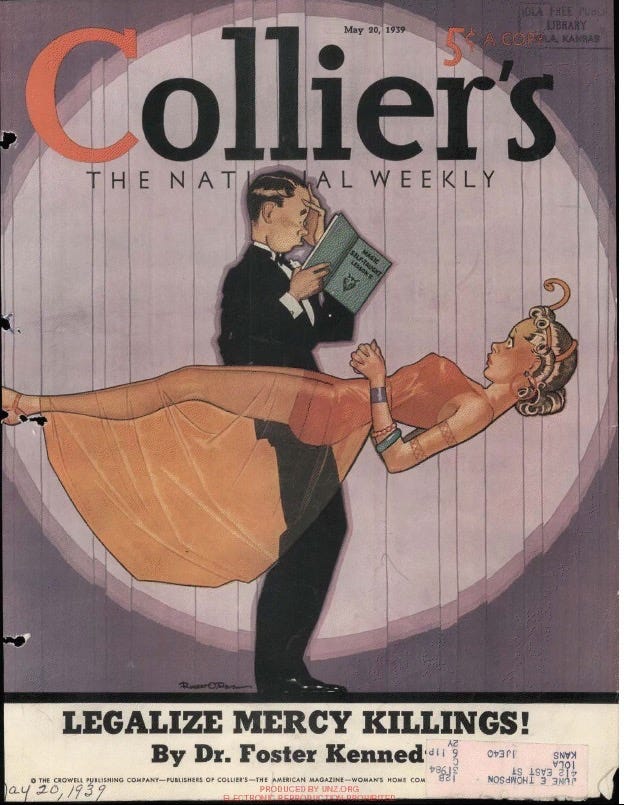
I temporize, relishing my power to spite medical genetics. On the wall above my daughter Niusha’s kitchen chair hangs an issue of Collier’s Magazine. Black letters spell out the title of the May 20, 1939, cover story: “Legalize Mercy Killing!” Inside, Dr. Foster Kennedy argues for euthanizing “nature’s mistakes” under the color of benevolence. “To these unfortunates we surely might be allowed legally to grant a dreamless and unending sleep.” The following year, the American Neurological Association elected Dr. Kennedy its president. Invited to address the American Psychological Association, he behooved scientists of good faith to cooperate in the extermination of every “retarded child over the age of five.” Meanwhile, over in Germany, nurses and doctors obligingly began murdering children with disabilities, gassing, starving, and mutilating the black flowers of civilization. In the pediatric killing wards, the Nazis perfected the technologies of a race science urged upon them by two generations of distinguished Americans.
Notes from Underground must be turning me paranoid. The year is 2022. We live in Cambridge, Massachusetts, not the St. Petersburg of 1864 or the Berlin of 1939. Foster Kennedy died in 1952, his eliminationist dreams unfulfilled. The Masonic Medical Research Institute started out in 1958 with a mission to eradicate rheumatic diseases. Dr. Kontaridis has been studying RASA-2 for a quarter century. I can think of no good reason to impeach her auspices. She sounds motivated by what Richard Feynman called “the pleasure of finding things out.” I like her. I should be careful not to turn Misha’s mystery into my personal fetish. I should sign the consent. I have to make dinner.
“Don’t do it,” Niusha interjects. My daughter has been eavesdropping on my side of the telephone conversation, clocking my equivocations.
“Why not?”
“Because if Misha wasn’t here, we’d be different people. He’s helped us. I’d be a lot less nice.”
The scientists have wagered that genes explain “what makes Misha Misha.” I have played both accomplice and accuser in a dance of imputation. The corollary we have all abdicated to the imaginings of a fourteen-year-old girl. Say her brother’s variations do determine his impairments and aberrant behaviors. How can anyone be sure they do not also determine his sanguinary traits — his private jokes, his rapture for music, his aureoles of sensory hallucination? What Niusha intuits is that being with him, as opposed to acting on him, allows his unique biology to engender no less unique relationships. The farragoes that make Misha Misha, in other words, make Niusha Niusha. In The Trouble With Being Born, Emil Cioran places her existential affirmation into an epigram: “The only way to reach another person at any depth is to move toward what is deepest in yourself.”’
So where does that leave my decision? I reckon up probabilities between the unrestrained telos of natural science and the legal fiction awaiting my signature. I reckon the Sherlock Holmeses of genetics will continue to flog the diagnostic junk drawer of “autism and other developmental disorders.” I reckon they will accuse more genes of associating with the DSM. I reckon rounded-up scores and dread diseases foretold will gaslight prospective parents into selective abortion, striking untold artifacts from the human family. If so, then the God’s-eye view, the view from nowhere, will progressively purify the species of variations of uncertain significance. Will the mini brains of the neverborn repose in the eternal winter of a freezer in Utica?
I reckon so. But a future in which two plus two always equals four shall not have my consent. I refuse to sign, come what may. Out of spite, out of ignorance, out of love, I cling to my forsaken bough on the far edge of science.
This essay originally appeared in Liberties in March 2026.