

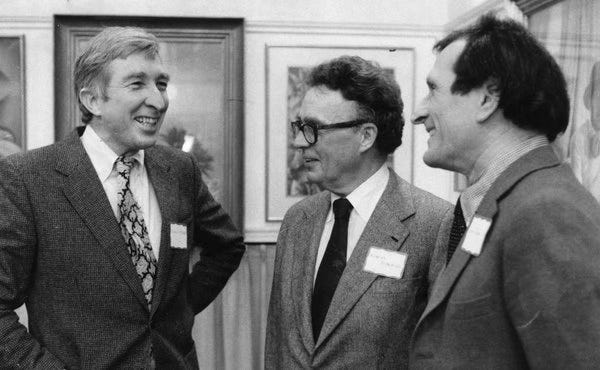
Justin Kaplan lived a good life, according to Twice Born: Finding My Father in the Margins of Biography (Catapult, 2025). After leaving his job as an editor at Simon and Schuster and relocating to Cambridge, Massachusetts, in 1959, he and his wife Anne Bernays settled into a large house on Francis Avenue. There, grinding out words behind the closed door of his study, he wrote Mr. Clemens and Mark Twain, Lincoln Steffens, and Walt Whitman. For his labors in biography he won a Pulitzer Prize, National Book Award, and American Book Award. Kaplan also wrote a social history of the Astor Family of New York and a fetching joint memoir with Bernays, Back Then: Two Literary Lives in 1950s New York. Unlike some writers of his generation, he didn’t gamble, fall to drink, or embarrass his three daughters with a scandal. His marriage lasted nearly sixty years. When he died, aged 88, Cambridge mourned him as one of the city’s last unaffiliated men of letters.
A successful career and unimpeachable private life would seem unpromising fodder for an interrogation. Twice Born, by middle daughter Hester Kaplan, zeroes in on Justin’s patrimonial disposition. “We never faced each other or found comfortable or honest footing because we were too alike: shy, cripplingly private,” she writes. When they talked, they discussed stories. “I felt alone with my father, always nervous with him, even as we talked, because I wasn’t really sure if it was us we were discussing.” Her father never came out and uttered the words, “I love you.” She called him by his nickname, Joe.
The gravamen of the indictment centers on his relationship to his past. By age thirteen, Justin Kaplan lost both parents to cancer. How did he cope with the catastrophe? What psychic formations crystallized as a result of the loss? Although he never kept his orphanhood a secret, he didn’t evince any interest in the details. He didn’t know where his parents had been buried. Once, Hester reports, he forgot his mother’s maiden name when applying for a passport. That one of America’s most acclaimed biographers showed no interest in his own biography is a trivial irony in itself. But Hester holds it up as the key to unlocking the provenance of his problem. In turning away from his past, he “avoided knowing his three daughters.”
In December, the National Book Critics Circle long-listed Twice Born for an award in autobiography. The book is indeed tenderly composed, and when it peeks into the social world, adroitly observed. For approximately 15 years, we learn, the Kaplan-Bernays home on Francis Avenue served as a hub of literary culture in Cambridge. John Kenneth Galbraith lived a few doors down, Julia Child across the back fence. John Updike, Annie Dillard, Kurt Vonnegut, and Bernard Malamud attended their parties. The vignettes are steeped in pathos. When the party ended, an injunction to silence gripped the neighborhood. “I had watched as an older boy dropped his clothes, one piece of a time, out of his bedroom window so that shirts and underwear and sneakers flew by his father working at a desk in the room below, the man barely looking up as though it had only been a bird’s shadow passing by.” Another child reported needing to make an appointment to see her father. As in Greg Bellow’s “Saul Bellow’s Heart” and Janna Malamud Smith’s “My Father is a Book,” Twice Born bears witness to an axiom of the scribbler’s vocation: all time away from the desk is stolen time.
The dominant image in this account sees Hester crouching outside the closed door of Justin’s study, wondering why she can’t enter. Yet we don’t learn whether her sisters or mother contemplated the same issue, or whether they conceived Justin’s incuriosity toward his past as a problem at all. They seldom appear in these pages. Hester wishes he had been a different sort of father, one more emotionally expressive, more engaged with her inner needs. Did he himself recognize their “lack of connection and inability to speak to and about each other”? A friend of eight decades tells Hester he never discussed his dead parents. “And I felt I shouldn’t ask,” the friend adds.
How much of our parents’ past do we deserve to know? Twice Born avoids the question by appealing to what the critic Parul Sehgal has called “the trauma plot.” The convention flattens character in order to impute a wound that explains all, exchanging mystery and uncertainty for a presumption of superiority. Hester charges her father with a failure of “courage” and “honesty” in confronting his “secret.” (What secret?) “He doesn’t know why he never looked back to discover how he weathered the deaths of his parents,” she writes. Perhaps orphanhood, prevalent in the 1930s, simply did not bear the same weight on his shoulders as Hester imagines it would have on hers. “I would not be like my father,” she swears when she becomes a writer despite herself. Whenever her children knock on her study, she assures us, she lets them in.
Reading her father’s great biographies after his death, Hester juxtaposes passages with feelings she imagines he must have inhabited as an orphaned boy. In this way, staging the conversation she never had with him, she “finds” her father “in the margins of biography,” as the subtitle claims. She offers us the origin story she wants him to have wanted. The catharsis is muted because the conflict seems one-sided, an exercise in therapeutic “acceptance” rather than increased understanding.
Twice Born is a warmhearted lament that miscarries over the central illusion of biography. No matter how much detail they amass, no matter how many witnesses they interview, no matter how many conversations they conduct or imagine with their subjects, biographers can transfigure only so much of time and character into cognizable history. Incorporate the methodological limitation, and the genre beguiles and humanizes in the same stroke. Fight the limitation, insist on penetrating to the core, and the genre deals in metaphysical conceit. Can any of us really know the inner lives of other people? Why should we even want total knowledge? “The fundamental measure of our humanity lies in what we cannot know about each other,” the anthropologist David Graeber argued. “To recognize another person as human is to recognize the limits of one’s possible knowledge of them.”
Justin Kaplan didn’t know his parents because they died when he was a boy. Hester Kaplan didn’t know her father because he didn’t care to reveal all of himself. The yearning for verification is human. So is our finitude.
(A version of this post also appears at Cambridge Day.)