
How scary was the Red Scare?
a review of Clay Risen's new history

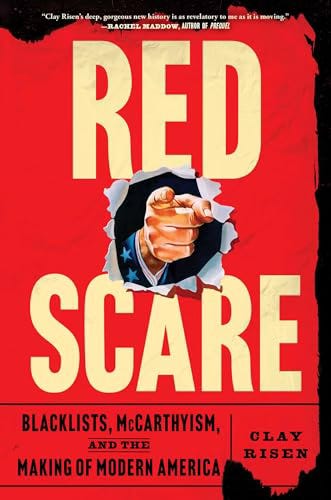
Clay Risen, Red Scare: Blacklists, McCarthyism, and the Making of Modern America. Scribner, 2025. Paperback: March 3.
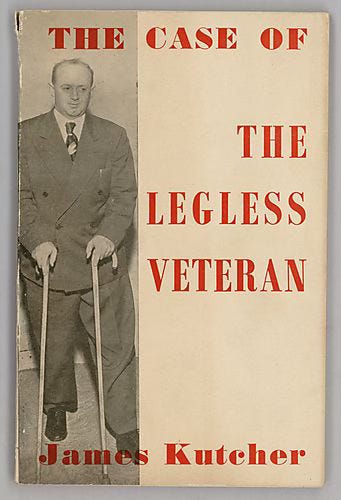
U.S. Army Private James Kutcher slipped away from the Battle of San Pietro to pee. In the next moment, a German mortar shell found him. Kutcher went home without his legs, moved into a subsidized housing unit in Newark with his elderly parents, and worked as a file clerk for the Veterans Administration. In 1947, four years after his injury, the VA fired him. The Army canceled his disability pension, and then a notice in the mail informed him and his parents they were to be evicted from their home. The Red Scare had found them. In particular, President Harry Truman signed Executive Order 9835, establishing a loyalty program for federal employees. Because Truman’s Attorney General placed the Socialist Workers Party on a list of subversive organizations, and because Kutcher belonged to the party since the 1930s, a file clerk accused of no substantive wrongdoing was retroactively classified as an enemy of the state he had sacrificed his legs to defend.
Kutcher sued to reclaim his rights of speech, association, and due process. Prominent figures such as John Dewey, C. Wright Mills, and I.F. Stone lent their names to the Kutcher Civil Rights Committee, which won a hearing from many Americans who did not share his politics. Kutcher took his artificial limbs on a tour to promote The Case of the Legless Veteran, his autobiography. “What has the majesty of the U.S. descended to,” the Washington Post asked, “when a crippled veteran can be so hounded and harassed in the name of national security?” No fired federal employee generated more public sympathy. No ordinary American did more to discredit the Red Scare. In 1956, a Circuit Court of Appeals reinstated Kutcher. Two years later, the U.S. Court of Claims returned his pension and pay. The rulings dealt the Attorney General’s List of Subversive Organizations a mortal blow.
Clay Risen begins The Red Scare with Truman’s loyalty program. He concludes in 1957 with a series of Supreme Court decisions limiting the government’s power to punish dissent. In the book’s four hundred pages, James Kutcher receives one passing mention. Boldfaced names hog the attention: Whitaker Chambers, Roy Cohn, Alger Hiss, the Hollywood Ten, J. Edgar Hoover, Senator Joseph McCarthy, Julius and Ethal Rosenberg, Henry Wallace. The action takes place not in subsidized housing, but at the White House, the House Un-American Activities Committee, tony hotels, and an occasional cocktail party.
Risen’s book is not without considerable merits. The prose is brisk, the detail sharp. That the theme is timely, even urgent, needs no elaboration—and the author gives none. Readers of the New York Times, where Risen works as a reporter, may need little help connecting the logic of guilt by association to NSPM-7, the Trump administration’s national security strategy. Others may see in the postwar repression a precursor to the current campaign to slander New York City Mayor Zohran Mamdani as foreign agitator, due solely to his membership in the Democratic Socialists of America. In these respects, The Red Scare is a useful book, well worth reading. Besides, one desultory nod to the disabled, working-class socialist does improve on Ellen Schreker’s Many are the Crimes and Richard Fried’s Nightmare in Red. Both major studies omit Kutcher entirely.
Like most histories of the Red Scare, Risen’s takes the phenomenon to be an invigilation. The storyline identifies a spate of “dark energy” that inculcated panic in the corridors of power running between Manhattan and Washington D.C. What needs to be explained, then, is why the repression “went far beyond what was necessary,” as Risen says. Given that the U.S. government controlled both oceans, owned half of the world’s wealth, and held a monopoly on the most powerful weapon in human history when the Red Scare began in 1947, a skeptical reader may wonder what proportion was necessary—and exactly who thought so.
Risen ascribes the loyalty program and its foreign policy companion, the Truman Doctrine, to a panic roiling the whole nation. “Observers in the United States,” he writes of responses to Winston Churchill’s “Iron Curtain” speech in Missouri, “were quick to conclude that the threat extended wherever Communism was found—even at home. Winning this new Cold War, they believed, would necessitate an unmitigated, unblinking effort to root out domestic subversion and dissent.” Which “observers?”Outside of Washington, public opinion snarled at Churchill’s incitement. Polls reported eighteen percent of Americans approved of the speech; more than forty percent disapproved.
“There was no question,” Risen continues in the vein of tragic necessity, that the Truman administration had to intervene in the Greek Civil War. “It is impossible to overstate just how overpowering the fear of a new world war became,” he asserts. Did the U.S. counterinsurgency destroy a popular, anti-Nazi resistance movement of Greek workers and peasants because officials felt overpowered by fear of a wider conflagration? The motivation imputed would be more credible if Risen had showed them pursuing measures to reduce the likelihood of world war three. He comes closest to doing so in praising President Dwight Eisenhower. IKE brought “a level of sanity to the Cold War through his New Look strategy, which reconceived the Soviet threat as a long-term, chronic challenge.”
On March 15, 1955, Eisenhower gave evidence of his level at a news conference. Asked whether his administration was prepared to use tactical atomic weapons in a general war against communism in the Far East, the genial president said sure why not: “I see no reason why they shouldn't be used just exactly as you would use a bullet.” Economic warfare, global counter-subversion, and atomic brinksmanship evidently count for sanity.
In truth, the repression was necessary only to the social classes and institutions that benefited from it. The Catholic Church and U.S. Chamber of Commerce, neither of which receives a page in Risen’s book, worked assiduously with the FBI to promote the devil theory of communism. Why? Because the rational interests of their institutions demanded they do so. The Chamber wanted to roll back the New Deal. The FBI wanted bureaucratic legitimacy for a secret police force. The Church, previously a target of counter-subversion, wanted to preserve its moral authority from Hollywood’s mass culture.
Robert Justin Goldstein’s Political Repression in America encompasses the wider and deeper context of global class war. What Risen describes as “the second red scare” was in truth the third or fourth. The first, transpiring between 1873 and 1878, reacted to restive industrial workers at home and the Paris Commune abroad. An ensuing half-century effort to outlaw the labor movement fostered the instruments of domestic repression that accompanied the two world wars and the Cold War, which replaced the immigrant working classes with the Soviet Union as chief scapegoat.
In American Blacklist, Goldstein calls the Attorney General’s List of Subversive Organizations “the single most important domestic factor that fostered and facilitated the Red Scare.” Risen scants the list because he treats the Red Scare as a narrative potboiler rather than class warfare. The mere existence of the list transformed conflicts over economic interests into anxieties over identity. An unlisted organization could not be presumed approved by the government. Countless Americans begged off signing any petition or attending any meeting, lest the AG plant the kiss of death that landed on James Kutcher.
It was not hysteria that motivated the mandarins at the acme of their power to isolate and censor left-wing thought and practice. The new national security apparatus they installed transformed dissent into criminal disloyalty to end political imagination itself. What the mandarins actually feared was the open competition of ideas enshrined in the Bill of Rights.
Today, as Washington prosecutes a forever war against the ideals of the American Revolution, dismantling what remained of the distinction between elected official and demagogue, the cognoscenti cock their ears for “vibes” and “dark energy.” But it’s not political physics. It’s not the jitters. Folks, it’s tyranny.
A version of this post is also published at Cambridge Day.
Great review. Yes, history doesn't repeat, but it certainly rhymes. It seems Americans have lost the ability to discern authoritarianism from healthy left-vs.-right debate.